Research
LOHC & Hydrogen System Economics
Turning catalyst and reactor decisions into cost per kilogram of hydrogen — techno-economic assessment across second-life fuel-cell power, hydrogen compression, and an overseas LOHC supply chain.
- Economics
Background
Materials and systems work only matters commercially if the economics pencil out, so a lot of my non-lab work translates catalyst and reactor decisions into cost-per-kilogram-of-hydrogen numbers comparable across technology options. That TEA capability spans several projects: a levelized-cost-of-hydrogen model built from scratch in spreadsheets for refueling-station economics, a TEA of the compressor stage in a high-pressure hydrogen system — detailed in Sodium Borohydride for Hydrogen Mobility & Compression — and the same model reused to compare competing system designs on a common cost basis.
What I did
- Modeled refueling-station LCOH from scratch and reused it to compare competing system designs on a common cost basis.
- Contributed a techno-economic assessment of the compressor stage in a high-pressure hydrogen system.
- Built a cost–benefit model for a 1 MW CHP plant on retired vehicle fuel-cell stacks — the contest-winning analysis.
- Modeled the levelized cost of an overseas LOHC green-hydrogen supply chain feeding a 1,000 MW co-firing plant.
Case study: second-life fuel-cell power
The contest-winning analysis starts from an asymmetry in how fuel-cell stacks age: automotive stacks retire at roughly 90% state-of-health after about 5,000 hours of hard duty cycling, while the same stack chemistry under steady stationary load points to lifetimes approaching 80,000 hours. A retired vehicle stack still holds most of its useful life, so the model prices that remainder: a 1 MW plant assembled from ~14 retired stacks (73.8 kW each), running 7,884 hours a year and selling electricity, district heat, and by-product hydrogen as fuel. Cost–benefit and break-even trajectories were discounted at 1.7%, the A+ corporate bond rate at the time.
Case study: LOHC supply-chain economics
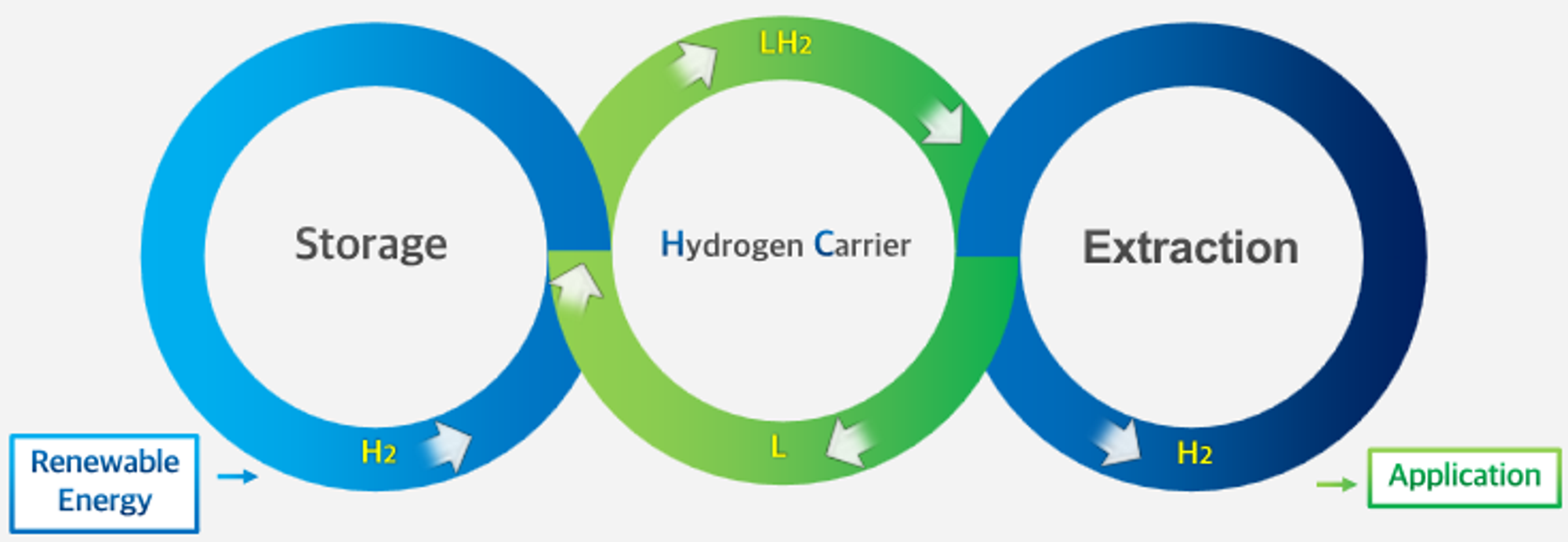
The LOHC model follows green hydrogen from an overseas production site to a Korean power plant: hydrogenation abroad, VLCC transport, dehydrogenation using the plant’s waste heat, and co-firing in a 1,000 MW LNG turbine. Process simulation sized CAPEX and OPEX at every stage and rolled them into a single delivered cost per kilogram. The real point is the sensitivity sweep — it turns catalyst KPIs into economic requirements, specifying how good the dehydrogenation catalyst’s space velocity and lifetime must be before the chain clears the bar against LNG-only operation.
Outcomes
The second-life stack analysis won First Prize at the 1st Future Automotive Industry Idea Contest (Foundation of Korea Automotive Parts Industry Promotion). It’s the same economics lens applied to a public idea-contest audience rather than a peer-reviewed one.