Research
Sodium Borohydride for Hydrogen Mobility & Compression
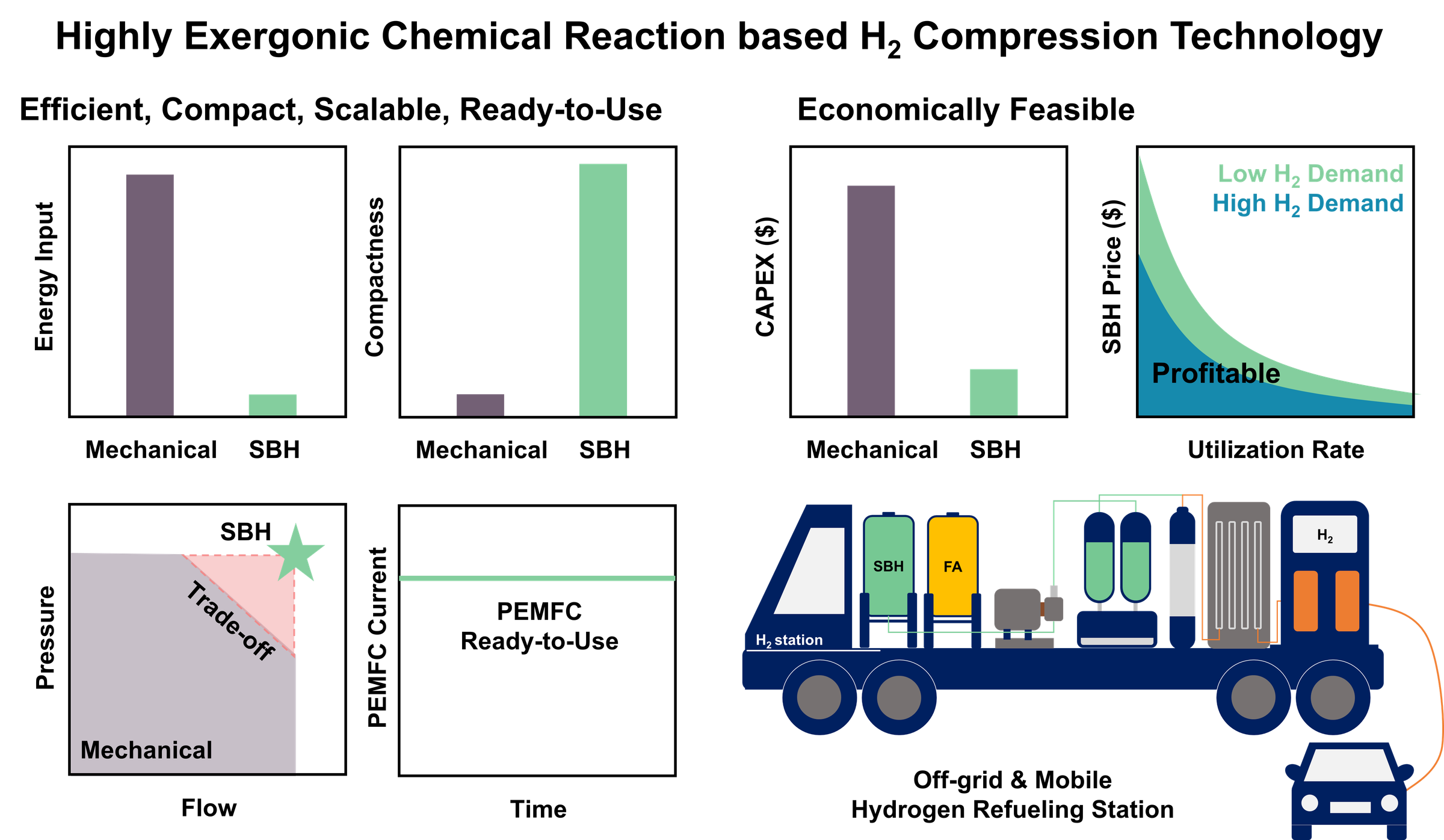
One shared chemistry — acid-mediated sodium borohydride hydrolysis — carried across a five-study arc with Hyundai since 2022, along two parallel tracks: an on-board hydrogen generation system and compressor-free high-pressure generation.
- Systems
- Materials
- Economics
Background
Sodium borohydride (NaBH₄) releases hydrogen on contact with water, and the reaction can be driven with an acid instead of a fixed catalyst bed. Since 2022, that one chemistry has carried a five-study arc with Hyundai.
The arc runs on two parallel tracks: an on-board generation system — a program led by Hyundai Rotem with Hyundai Motor Company that I’ve been on for going on five years — and compressor-free high-pressure generation: sequential reactions to 650 bar, the catalyst mechanisms behind 817 bar output, and a scale-up to a working 500 bar refueling system. Both tracks share a byproduct problem: the same reaction makes CO that has to be scrubbed on the reactor’s own heat, and that became its own line of catalyst and patent work.
What I did
- Conceptualization and techno-economic assessment for the 650 bar sequential-compression study.
- Designed and built the reaction apparatus and mechanism experiments behind 817 bar high-purity output.
- First author on the arc’s peak: a 500 bar grid-independent, mobile refueling system with no mechanical compressor.
- Led the CO purification catalyst end to end — catalyst, preparation method, system design, evaluation — filed as a patent application (lead inventor).
Outcomes
The arc’s peak is a working system, not just a lab result:
- 500 bar directly from NaBH₄ hydrolysis — no compressor stage, no grid power. First-author paper in Chemical Engineering Journal.
- The CO purification thread spans a filed patent (lead inventor), a co-authored catalyst paper, and a co-first-authored paper in the International Journal of Hydrogen Energy (2026).
The on-board generation system was publicly demonstrated at ADEX 2025.
Related publications
High-Pressure, Grid-Independent Hydrogen Generation via Chemical Hydride Hydrolysis: Demonstration and Deployment Strategies
Chemical Engineering Journal, 2025
First author
“From lab bench to a working high-pressure, grid-independent hydrogen generator.”
doi.org/10.1016/j.cej.2025.162983Sequential reactions toward a high-pressure H₂ generation from a mixture of sodium borohydride and formic acid
Cell Reports Physical Science, 2024
Co-author
Contribution: Conceptualization, techno-economic assessment
doi.org/10.1016/j.xcrp.2023.101759Novel Roles of Catalysts in Producing High-Purity High-Pressure Hydrogen from Sodium Borohydride
ChemSusChem, 2024
Co-author
doi.org/10.1002/cssc.202401694Pore Surface Engineering of Al₂O₃-supported Ru Catalysts with TiO₂ for Enhanced Selective CO Methanation
Applied Surface Science, 2024
Co-author
Contribution: Experiments, catalyst characterization, reaction product analysis
doi.org/10.1016/j.apsusc.2024.159551