Research
Plasmon-Enhanced Photothermal NH₃ Decomposition
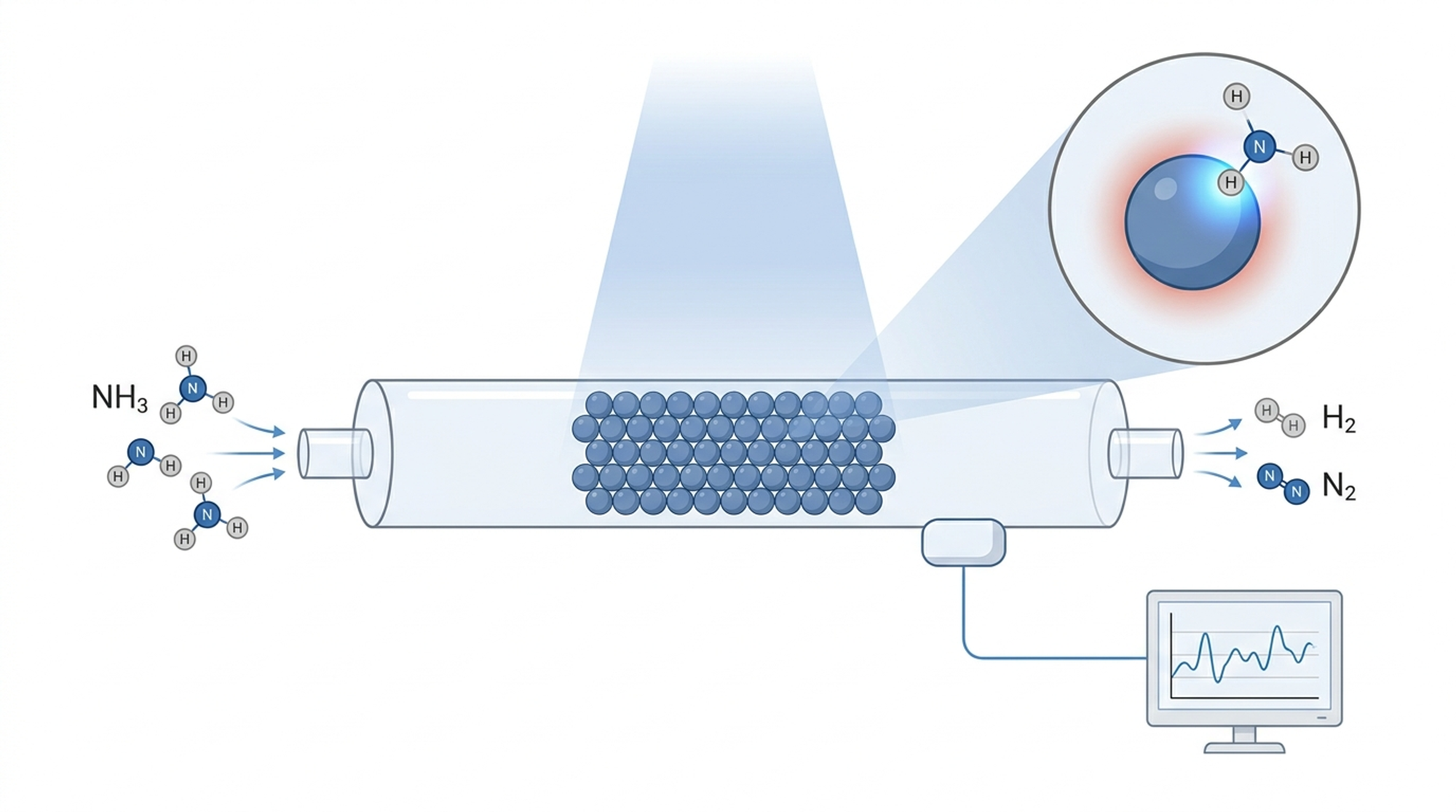
Designing a photothermal reactor system and the plasmonic catalyst inside it to crack ammonia — a dense, storable hydrogen carrier — back into usable H₂, with a self-built data pipeline running underneath the work.
- Materials
- Systems
- Code
Background
Hydrogen is a low-density gas that’s hard to store and move without deep cryogenics or heavy pressure vessels. Ammonia sidesteps that problem — it carries roughly 1.7 times the volumetric hydrogen density of liquid hydrogen and can move through existing shipping and pipeline infrastructure built for fertilizer. The catch: ammonia has to be decomposed back into hydrogen at the point of use, and that decomposition step is where most of the remaining engineering difficulty sits.
My approach treats this as a full-stack problem: I design and build the photothermal reactor system — optical path, reaction cell, gas handling — and develop the plasmon-enhanced photothermal catalyst that runs inside it. A data pipeline I built automates collection and GC analysis underneath both — the same build-the-tool instinct that shows up across the rest of my work (see Code).
What I did
- Designed and built the photothermal reactor system — optical path, reaction cell, gas handling.
- Developed the plasmon-enhanced photothermal catalyst used inside the reactor.
- Built lat-pipeline and gc-analysis to automate lab data collection and GC processing.lat-pipelinegc-analysis
Outcomes
Two threads, at different stages:
- The photothermal reactor and catalyst study is still in progress, with no publication yet.
- A same-lab collaboration in Prof. Jungwon Park’s group at Seoul National University produced a co-authored Science paper — my contribution was in-situ DRIFTS analysis, tracking how supported platinum clusters’ catalytic behavior changes atom by atom.
Related publications
Dependence of catalytic properties of strongly supported platinum clusters with atom counts
Science, 2026 · Vol. 392, No. 6801, pp. 958–965
Co-author
Contribution: In-situ DRIFTS analysis
“How the catalytic behavior of supported platinum clusters changes atom by atom.”
doi.org/10.1126/science.aeb3087